|

TURKISH
TOURISM , SME's & REGIONAL DEVELOPMENT
Prepared
for " The Role of SME's
in Regional Tourism & Local Capacity Building
" Meeting in
Russian Federation , St.Petersburg, 18-20 November 1999 .
Mehmet Atilla SOGUT
TURKISH TOURISM
WHY TURKEY
INSTITUTIONAL STRUCTURE
LEGAL FRAMEWORK
STATE AIDS for
INVESTMENT TO TOURISM SECTOR
INPUT / OUTPUT ANALIS
of TOURISM SECTOR
PROJECTS Of TURSAB for 2000
TURKISH TOURISM
After 1984, tourism has
become one of the most important sectors of the Turkish economy contributing
a great deal to foreign exchange reserves and national product.
Because of Turkey’s tremendous
tourism potential with;
-
8333 kilometers of
coastline with an extensive selection of beaches, ideal for any type of
marine activities,
-
Contrasting
geographical regions with varied geomorphology and different climatic
features ranging from temperate climate on the north, to typical
continental inland and sup-tropical Mediterranean on the South,
-
Correspondingly
diverse flora and fauna; natural resources including rivers, mountains,
potential for winter sports, various kinds of activity and summer
holidays,
-
More than a thousand
thermal resources,
-
Historical and
cultural heritage of nearly 10.000 years,
-
Fascinating remains
of many successive civilizations,
-
Istanbul, a worldwide
attraction, typical towns, rural settlements with their own way of life,
-
Natural wonders such
as Pamukkale and Cappadocia coupled with extraordinary archaeological
assets,
expectations were high
from this sector;
Promotion activities
related with tourism sector has been started in early of 1970’s . A coastal
strip from Balıkesir provincial border, up to the end of Antalya province
which included Izmir, Kusadasi, Bodrum, Marmaris and the other popular
destinations of today was declared priority region to concentrate both
public and private investments, then tourism orientated physical planning
works were initiated by the Ministry of Tourism, in co-ordination with the
Ministry of Reconstruction and Re-settlement.
In 1982 the new
Tourism Encouragement Law No.2634 which introduced new incentives
including government land allocations to private tourism investors, also
giving more authority to Ministry of Tourism for the definition of
development areas and planning was put in effect. Charter restrictions on
certain routes were lifted. Also more funds for government investments and
for credit facilities for encouragement of private sector were made
available.
Since early 1980’s in
line with investments on infra and super structure and rapid increase in the
number of tourist beds, Turkey has made considerable investments on
communication network, and transformed the system with the most advanced
technology connecting even remotest villages throughout Turkey to the
national network.
Air transport has been
another area of achievements. Turkish Airlines has been one of the fastest
growing companies in the world, enjoying a very high load factor both in
domestic and international flights.Turkish private air companies
started operations also expanding their business every year. Relatively low
rate foreign charter flights have also contributed to rapid increase of
tourists, flocking in mass numbers to Turkey.
Table :
AIR TRANSPORTATION FACILITIES
|
PUBLIC (THY) |
PRIVATE |
TOTAL |
|
Year |
No. of Plane |
Seats |
No. of Plane |
Seats |
No .of Plane |
Seats |
|
1992 |
40 |
6566 |
40 |
6273 |
80 |
12839 |
|
1993 |
58 |
9275 |
42 |
7046 |
100 |
16321 |
|
1994 |
56 |
9797 |
45 |
7708 |
101 |
17505 |
|
1995 |
57 |
9201 |
57 |
10278 |
114 |
19479 |
|
1996 |
62 |
9869 |
58 |
11301 |
120 |
21170 |
|
1997 |
63 |
10038 |
59 |
11587 |
122 |
21455 |
|
1998 |
69 |
10911 |
63 |
12236 |
132 |
|
Turkey as a country with
8333 km of coastline , still continues to develop summer holiday facilities
,also Winter
holiday and sports, mountaineering, sub-aqua diving, tracking, golfing,
horse riding and all other activity holidays, cultural tours, special
interest tours for enthusiasts, spas, meetings, incentive travel and all
other tourist activities have been taken as priority issues to utilize the
wide range of diverse resources.
Table :
YACHTS ESTABLISHMENTS OF TURKEY
With all these positive
developments , Now , Turkey is one of the leading country for the major
tourist generating markets of Europe where tour operators were in search of
new destinations.
Although Turkey entered
the world tourism and travel market later than others, it showed a rapid and
sustained growth compared with its competitors and leading tourist receiving
countries. In
1990, Turkey was the 24th most visited country in the world and
today it is 18th. On the other hand Turkey’s ranking among top
earners is 12th whereas it was 21st in 1990.
Table :
TOP
20 in the World Tourism ( ** Excluding same-day visitors )
Tourist Arrivals
| No |
Millions |
% of
World Total |
| 1 . France |
70,0 |
11,2 |
| 2 . Spain |
47,7 |
7,6 |
| 3 . USA |
47,1 |
7,5 |
| 4 . Italy |
34,8 |
5,6 |
| 5 . U.Kingdom |
25,5 |
4,1 |
| 6 . China
|
24,0 |
3,8 |
| 7 . Mexico |
19,3 |
3,1 |
| 8 . Poland |
18,8 |
3,0 |
| 9 . Canada |
18,7 |
3,0 |
| 10 .
Austria |
17,3 |
2,8 |
| 11 .
Germany |
16,5 |
2,6 |
| 12 . Czech
Rep. |
16,3 |
2,6 |
| 13 .
Russian Fed. |
15,8 |
2,5 |
| 14 .
Hungary |
14,7 |
2,3 |
| 15 .
Portugal |
11,8 |
1,9 |
| 16 . Greece |
11,1 |
1,8 |
| 17 .
Switzerland |
11,0 |
1,8 |
| 18 . Hong
Kong |
9,6 |
1,5 |
| 19
. Turkey |
9,2 |
1,5 |
| 20 .
Thailand |
7,7 |
1,2 |
| “Top 20”
Total |
446,9 |
71,5 |
| World
Total |
625,2 |
100,0 |
Tourism Receipts
| No |
Billion $ |
% of
World Total |
| 1 . USA |
74,2 |
16,7 |
| 2 .
Italy |
30,4 |
6,8 |
| 3 .
France |
29,7 |
6,7 |
| 4 .
Spain |
29,6 |
6,7 |
| 5 . U.Kingdom |
21,3 |
4,8 |
| 6 .
Germany |
16,8 |
3,8 |
| 7 .
China |
12,5 |
2,8 |
| 8 .
Austria |
12,2 |
2,7 |
| 9 .
Canada |
9,1 |
2,1 |
| 10 .
Australia |
8,6 |
1,9 |
|
11 . Poland |
8,4 |
1,9 |
|
12 . Turkey |
8,3 |
1,9 |
| 13 .
Switzerland |
8,2 |
1,8 |
| 14 .
Mexico |
7,9 |
1,8 |
| 15 .
Hong Kong |
7,1 |
1,6 |
| 16 .
Russian Fed |
7,1 |
1,6 |
| 17 .
Singapore |
6,5 |
1,5 |
| 18 .
Thailand |
6,4 |
1,4 |
| 19 .
Netherlands |
5,7 |
1,3 |
| 20 . S.
Korea |
5,7 |
1,3 |
| “Top
20” Total |
315,7 |
71,0 |
|
World Total |
444,7 |
100,0 |
Table
: NUMBER OF
VISITORS AND TOURISM RECEIPTS BY YEARS
|
YEARS |
Number Of VISITORS
(000) |
TOURISM RECEIPTS
(Million $) |
|
1963 |
198 |
7 |
|
1969 |
694 |
36 |
|
1975 |
1,540 |
200 |
|
1980 |
1,288 |
326 |
|
1985 |
2,614 |
1,482 |
|
1990 |
5,389 |
2,705 |
|
1991 |
5,517 |
2,654 |
|
1992 |
7,076 |
3,639 |
|
1993 |
6,500 |
3,959 |
|
1994 |
6,670 |
4,321 |
|
1995 |
7,726 |
4,957 |
|
1996 |
8,614 |
5,650 |
|
1997 |
9689 |
7.080 |
|
1998 |
9431 |
7.177 |
Table :
Distribution of Tourist Arrivals by Main Countries of Nationality
| |
1996 |
% |
1997 |
% |
1998 |
% |
|
1 . Germany |
2.141.778 |
24,9 |
2.338.529 |
24,1 |
2.333.740 |
23,9 |
|
2 . UIS |
1.582.423 |
18,4 |
1.513.566 |
15,6 |
1.311.357 |
13,4 |
|
3 . United Kingdom |
758.433 |
8,8 |
915.337 |
9,4 |
996.512 |
10,2 |
|
4 . Romania |
191.511 |
2,2 |
338.966 |
3,5 |
505.766 |
5,2 |
|
5 . USA |
326.214 |
3,8 |
364.764 |
3,8 |
439.885 |
4,5 |
|
6 . France |
251.976 |
2,9 |
333.781 |
3,4 |
436.932 |
4,5 |
|
7 . Netherlands |
216.672 |
2,5 |
263.367 |
2,7 |
328.002 |
3,4 |
|
8 . Iran |
378.130 |
4,4 |
331.666 |
3,4 |
304.924 |
3,1 |
|
9 . Italy |
160.118 |
1,9 |
207.887 |
2,1 |
259.483 |
2,7 |
|
10 . Bulgaria |
139.301 |
1,6 |
219.353 |
2,3 |
244.741 |
2,5 |
|
11 . Israel |
254.445 |
3,0 |
263.423 |
2,7 |
238.298 |
2,4 |
|
12 . Austria |
235.540 |
2,7 |
307.528 |
3,2 |
235.120 |
2,4 |
|
13 . Belgium |
163.944 |
1,9 |
199.171 |
2,1 |
191.173 |
2,0 |
|
14 . Others |
1.813.600 |
21,1 |
2.091.666 |
21,6 |
1.926.764 |
19,8 |
|
Total |
8.614.085 |
100,0 |
9.689.004 |
100,0 |
9.752.697 |
100, |
Table :
Distribution of Tourist Arrivals by Means of Transport
| |
1994 |
1996 |
1997 |
1998 |
| Air |
3.951.233 |
59,2 |
6.239.925 |
72,4 |
7.019.729 |
72,5 |
6.698.882 |
68,7 |
| Land |
1.824.635 |
27,4 |
1.360.328 |
15,8 |
1.576.038 |
16,3 |
1.794.563 |
18,4 |
|
Train |
61.934 |
0,9 |
91.929 |
1,1 |
140,072 |
1,4 |
148.172 |
1,5 |
| Sea |
832.816 |
12,5 |
921.903 |
10,7 |
953.165 |
9,8 |
1.111.080 |
11,4 |
| Total |
6.670.618 |
100,0 |
8.614.085 |
100,0 |
9.689.004 |
100,0 |
9.752.697 |
100,0 |
WHY TURKEY
There is
a general consensus of opinion that cost of traveling to Turkey is more
reasonable than others. In fact comparable evidence based on consumer goods
and services revealed by OECD and travel trade magazines confirms this
statement.
Prices
in Turkey and in its competitors, $
|
Goods & Ser. |
Spain
|
Greece
|
Turkey |
Port. |
Italy
|
France |
|
0.3 Lt Bear
|
1.49
|
1.14
|
0.65 |
0.85
|
1.41
|
2.32 |
|
Coffee |
0.98 |
1.64
|
0.65
|
0.45
|
0.83 |
1.68 |
|
1 Lt Milk
|
0.77 |
1.09 |
0.82
|
0.90 |
1.21
|
1.06 |
|
Taxi(10 min)
|
5.95
|
6.56
|
2.46 |
5.93 |
6.92
|
9.54 |
|
Wine (a bottle)
|
1.49
|
3.28 |
1.96 |
3.14 |
1.72 |
3.18 |
|
A Bread |
0.90 |
0.91 |
0.19 |
0.73 |
1.08 |
0.78 |
|
Film (24) |
1.49
|
5.90 |
3.93
|
4.11 |
6.26
|
5.29 |
|
Meal( 2 person) |
42.5 |
29.52 |
16.4 |
34.93 |
47.56 |
42.64 |
|
Total cost |
56.74 |
50.04 |
27.06 |
51.04 |
66.99 |
66.49 |
|
Source:
Travel Weekly (Jun 1997): From Lunn Polly Research. |
However,
research results and consumer surveys clearly show that price is the most
important but not the sole decision making factor. Quality, natural and
cultural values are also factors attracting tourists to Turkey.
|
Why Turkey |
% |
|
Price (Reasonable travel coast) |
25 |
|
Curiosity about Turkey |
20 |
|
Getting to know Turkish people better |
19 |
|
Shopping |
15 |
|
Business |
6 |
|
Quality
|
3 |
|
Turkish cuisine |
2 |
|
Others |
10 |
|
Source: Ministry
of Tourism, SIS |
INSTITUTIONAL STRUCTURE
Since the importance of
small-scale enterprises has been recognized in most of the developed or
developing countries, appropriate policies by the government have been
considered to foster such units and some special organizations have been
established .The organizational structure which directly related to the
promotion of Tourism Sector in Turkey can namely be listed below;
The Ministry of Tourism
is the government authority responsible for tourism. The main role of the
Ministry is co-ordination of affairs, dealing with problems of the sector,
preparing grounds and conditions for development, encouragement of the
private sector as well as inspection of tourist facilities.
The Ministry of Tourism
sets out policy measures and determines priorities both for the incentives
and for encouragement of private enterprise as well as for public sector
investments. The Ministry is also the authority, which licenses
tourism investments and operating establishments. Travel Agencies have to
obtain a certificate from the Ministry and be registered with the
Association of Turkish Travel Agencies (TURSAB).
Training of personnel and
tourist guides is another area of responsibility, of the Ministry. Ministry
also conducts research and can prepare physical plans of priority areas
(tourism areas and centres), and allocate public owned sites to tourism
investments in compliance with laws and regulations.
Promotion of Turkey as a
tourist destination is also among the important duties of the Ministry of
Tourism while marketing is the business of private sector.
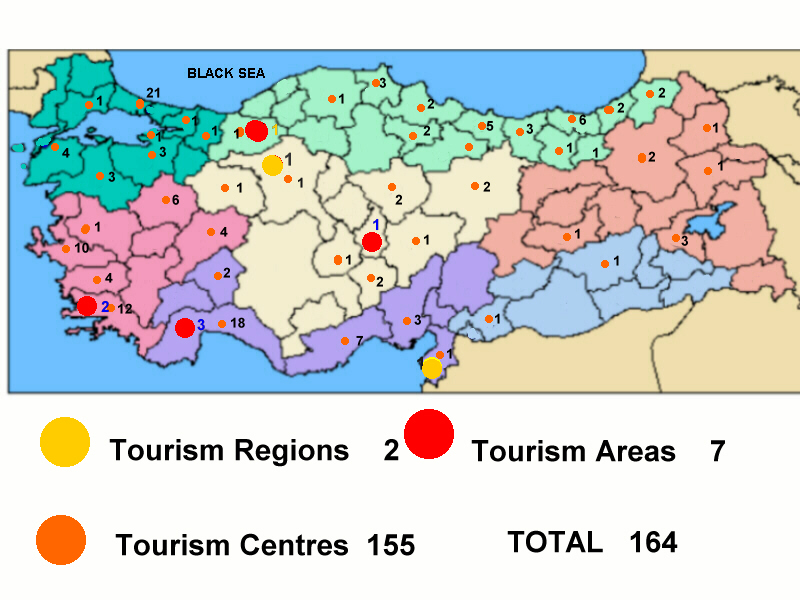
Tourism Regions:
Regions declared their borderlines by the Decree of Council of Ministers
with the Ministry of Tourism proposal,
Tourism Areas: Areas
in tourism regions with natural or socio-cultural worthiness given priority
in tourism development and declared their areas and borders by the Decree of
Council of Ministers and the Ministry’s proposal,
Tourism Centers:
Places in/out tourism regions with an importance of tourism aspect and
declared their places, areas and borders by the Decree of Council of
Ministers and the Ministry’s proposal,
Tourism Enterprises: Trade firms in tourism sector established
together or separately by real or legal entities with Turkish or foreign
citizens,
Tourism Investment Certificate: The certificate given by the
Ministry to the investors for the investment term declared,
Tourism Enterprise Certificate: The certificate given by the
Ministry to the enterprises in tourism sector,
Tourism Enterprises or Tourism Investments with Certificate: The
enterprises or investments given certificates by the Ministry ,The
enterprises or investments with tourism certificates pay the electric, gas
and water fees on the least price of the price list applied industrial
enterprises and houses.
Yacht: Ships registered as yacht in the measurement
certificate and all marine vehicles used for traveling and sports and not
used for cargo in case of having no measurement certificate,
Natural, historical, archeologic and socio-cultural tourism values,
winter, hunting and water sports and health tourism and other tourism
potential are taken into consideration in the determination of tourism
regions, tourism areas and tourism centers.
SECTOR ORGANIZATIONS
Association of Turkish Travel Agencies (TURSAB)
TURSAB is a non-profit
making organization and a legal personality which has been established under
Law No.1618 which came into effect in 1972.
The Association aims to
develop and promote travel agency profession as well as tourism both at home
and abroad. All travel agencies must be licensed by the Ministry of Tourism
and be registered by TURSAB in order to be able to conduct travel agency
business.
Travel agencies
Travel agencies are divided into
three categories according to Law No.1618 as: A, B, C.
A Group travel agencies, can provide all
services. (Travel agencies services also cover tour operators, ground
operators, DMCs, PCOs, Incentive House, Rent a Car services.)
B
Group travel agencies’ activities are confined to ticketing and
retailing Group A Tours and packages.
C
Group agencies organize tours for domestic market only.
Travel agency business has flourished parallel with
development of Turkish tourism. A great leap in the number of travel
agencies has been observed since 1990 reaching a total of 4300 by January
1999.
Table NUMBER OF AGENCIES BY GROUPS
|
|
|
A |
A-P(x) |
B |
C |
TOTAL |
|
Head Office |
1583 |
1160 |
187 |
390 |
3320 |
|
Branch |
800 |
124 |
23 |
55 |
1002 |
|
TOTAL |
|
2383 |
1284 |
210 |
445 |
4322 |
(x) A-P indicates those agencies
which receive provisional operating certificate
Turkish travel agencies offer wide range of products to
satisfy demand of any segment of market; most travel agencies diversified
their field of activity while some others are specialized in specific areas.
Turkish travel agencies have gained valuable experiences
through decades when tourist trends were fluctuating because of internal and
external problems. Some agencies have also established travel agency and
tour operation business abroad and accomplished success under severe
competitive market situation.
TURSAB awards travel agencies, which bring annually
more than one million dollars foreign currency in Turkey. Awarded agencies
have increased from 58 in 1986 to 155 in 1997.
OTHER PRIVATE ORGANIZATIONS
Hoteliers are organized
under different associations. Turkish Hotel Association TUROB is one of the
leading sector organizations, which represents an important part of Turkish
accommodation industry.
Turkish Tourism Investor
Association TYD, is another leading organization of tourism sector which
represents major investors in tourism.
Private airline companies
have a similar Association titled TOSHID ‘Turkish Private Air carriers
Association’. Turkish Airlines at present is a state economic enterprise.
Coach operations or bus
companies have also been united under the title of Association of Bus
Operators. So are the tourists guides, as they also have their own
associations.
To sum up the
organizational structure, all branches of tourist industry have established
their own independent organization or association. The only Association
which has been established by a special law is the Association of
Turkish Travel Agencies. (TURSAB)
LEGAL FRAMEWORK
There are a large number
of legislations directly or indirectly related to tourism. However the main
ones pertaining to tourism are as follows.
Five Year Development
Plans are prepared by the State Planning Organization and following the
legal procedures they are put in effect when the bill is passed by
Parliament. They are imperative for the public sector while they provide
guidelines for the private sector.
Decree Law on The
Organisation and Duties of the Ministry of Tourism No.355 came in force on
03 March 1989. (The Ministry was established in 1963 by Law Number 265)
Travel Agencies and Union
of Travel Agencies Law No.1618 was put in effect on 29 September 1972.
Encouragement of
Tourism Law No.2634 passed by Parliament on 12 March 1982 and replaced Law
No.6086 which was in operation since early 1960’s. The basic philosophy
has remained the same however more incentives were introduced and the
Ministry was given more authority in certain areas. The law also introduced
articles for special segments of industry expanding the scope of activities
previously covered.
Incentives based on the
new legislation and Government economic policies were:
-
Allocation of public
lands to investors on long term basis,
-
Provision of main
infrastructure by state,
-
Long, medium and
short term credit facilities for construction, furnishing and operation
respectively,
-
Preferential tariff
rates for electricity, water, and gas consumption, in priority areas and
centres,
-
Priorities for
communication installation,
-
Foreign personnel
employment in compliance with law up to 20 % of total,
-
Some exemptions from
customs tax,
-
Encouragement
premium,
-
Investment
allowance,
-
Resource utilization
support fund premium,
-
Exemption of tax,
duties and fees for long and medium term investment credits,
-
Exemption from
building construction duties,
-
Postponement of value
added taxes .
The basic concept of the
first Tourism Encouragement Law was, to build up a new modern tourist
industry, more specifically on accommodation industry and tourist facilities
rather than controlling the existing ones and grading them. Thus the law did
not necessarily cover the whole industry contrary to those in many other
countries, but it set out certain standards through relevant regulations for
those enterprises who might wish to enjoy certain incentives and
encouragement measures introduced by law.
Facilities as such, used
to be and are still licensed by The Ministry of Tourism provided that they
conform to the terms and regulations of the said law as well as the
nation-wide standards required.
Those facilities which
did not conform to the standards or were unwilling to obtain a tourist
license from the Ministry, remained under the control of local authorities
namely Municipalities. However they can always obtain a license from the
Ministry provided that they satisfy terms and conditions of the above
mentioned legislation.
Important Regulations
Pertaining to Tourism are;
-
Regulations
Pertaining to Travel Agencies.
-
Regulations
Pertaining to Association of Travel Agencies.
-
Regulations
concerning the Establishment of Tourism Training Centers
-
Regulations on Basic
Training Courses of Accommodation and Catering Establishments.
-
Regulations on
Professional Tourist Guides.
-
Regulations on
Inspection of Investments and Operations.
-
Regulations on
Allocation of Public Land for Tourism Investments.
-
Regulations on the
Qualifications of Tourism Investments and Operations.
-
Regulations on
Foreign Personnel and performing Artists in Licensed Tourism
Establishments.
-
Regulations,
Pertaining to Preparation of Implementation Plans and Approval of
Tourism Areas and Tourism Centers.
-
Regulations on Yacht
Tourism.
The legislation above
includes important laws and regulations directly related to tourism.
There is a long list of
other laws and regulations concerning tourism such as Coastal Law,
Environmental Law, Forestry Law, Reconstruction Law, Turkish Commerce Law,
Foreign Capital Investments Law, Tax Laws etc.
According to the 1994 Census of
Business Establishments ,the total number of tourism establishments Hotel ,
Motel, etc is 6316 and the Small and Medium establishments comprises the
97.2 % . Restaurants, Cafes, Bars, etc. is 110826and 100 % of them can be
categorized as Small and Medium establishments. The Table , gives the
number and share of the Turkish small, medium and large tourism enterprises
in terms of the total number of establishments, and the number of workers
employed. It is clear from the Table , that ,Small and Medium Tourism
Enterprises are predominant in Turkey , When the people who are not
affiliated with social security organizations are taken into account , this
ratio is evidently grow.
|
Distribution of Business Establishments in Tourism Sectors and
Number of employees for the Year of 1992 |
|
Sectors
and Size of Businesess |
Number
of Business |
Number
of Employees |
Owners
and Partnes |
Unpaid
Family Worker |
Total
Employment |
|
Sector / Workers |
Number |
% |
Number |
% |
Number |
% |
Number |
% |
Number |
% |
|
Hotel, Motel, etc. |
|
|
|
|
|
|
|
|
|
|
|
1-4 |
3.984 |
63.1 |
2.864 |
6.2 |
4.160 |
64.5 |
2.095 |
61.8 |
9.119 |
16.2 |
|
1-9 |
5.339 |
84.5 |
8.992 |
19.4 |
5.659 |
87.7 |
3.160 |
93.2 |
17.811 |
31.7 |
|
10-49 |
801 |
12.7 |
14.629 |
31.5 |
749 |
11.6 |
227 |
6.7 |
15.605 |
27.7 |
|
1-49 |
6.140 |
97.2 |
23.621 |
50.9 |
6.408 |
99.3 |
3.387 |
99.9 |
33.416 |
59.4 |
|
50-99 |
103
|
1.6 |
7.035
|
15.2 |
27
|
0.4 |
4
|
0.1 |
7.066
|
12.6 |
|
100+ |
73
|
1.2 |
15.765
|
34.0 |
15
|
0.2 |
-
|
0.0 |
15.780
|
28.0 |
|
TOTAL |
6.316
|
100.0 |
46.421
|
100.0 |
6.450
|
100.0 |
3.391
|
100.0 |
56.262
|
100.0 |
| |
|
|
|
|
|
|
|
|
|
|
|
|
Restaurants, Cafes, Bars,
etc. |
|
|
|
|
|
|
|
|
|
|
|
1-4 |
99.451 |
89.7 |
46.968 |
42.5 |
100.939 |
88.2 |
35.790 |
80.1 |
183.697 |
68.1 |
|
1-9 |
109.058 |
98.4 |
85.787 |
77.7 |
112.102 |
98.0 |
43.640 |
97.7 |
241.529 |
89.6 |
|
10-49 |
1.737 |
1.6 |
22.343 |
20.2 |
2.268 |
2.0 |
1.046 |
2.3 |
25.657 |
9.5 |
|
1-49 |
110.795 |
100.0 |
108.220 |
97.9 |
114.370 |
100.0 |
44.686 |
100.0 |
267.186 |
|
|
50-99 |
26
|
0.0 |
1.559
|
1.4 |
19
|
0.0 |
|
0.0 |
1.579
|
0.6 |
|
100+ |
5
|
0.0 |
787
|
0.7 |
2
|
0.0 |
1
|
0.0 |
789
|
0.3 |
|
TOTAL |
110.826
|
100.0 |
110.476
|
100.0 |
114.391
|
100.0 |
44.687
|
100.0 |
269.554
|
100.0 |
| |
|
|
|
|
|
|
|
|
|
|
|
However
, if we consider the establishments licensed by Ministry
of Tourism ;
|
TYPE |
CLASS |
OPERATION LICENSED |
INVESTMENT LICENSED |
|
EST. |
ROOMS |
BEDS |
EST. |
ROOMS |
BEDS |
|
HOTELS |
5* |
99 |
27469 |
58051 |
67 |
18823 |
41061 |
|
4* |
176 |
23553 |
48216 |
135 |
22041 |
46320 |
|
3* |
448 |
35653 |
72261 |
356 |
29565 |
61213 |
|
2* |
606 |
25487 |
50175 |
441 |
19002 |
38605 |
|
1* |
189 |
6252 |
11885 |
83 |
2007 |
4057 |
|
MOTELS |
1th & 2nd class |
34 |
1173 |
2330 |
26 |
592 |
1146 |
|
HOLIDAY VILLAGES |
1th & 2nd class |
80 |
22420 |
48898 |
70 |
16443 |
35311 |
|
BOARDING HOUSE |
|
182 |
3104 |
6070 |
145 |
2504 |
4893 |
|
CAMPINGS |
|
17 |
1700 |
5090 |
9 |
987 |
2805 |
|
THERMAL HOTELS |
|
16 |
1800 |
3656 |
- |
- |
- |
|
APART HOTELS |
|
36 |
1143 |
2964 |
- |
- |
- |
|
SPECIAL LICENSED |
|
72 |
2111 |
4834 |
16 |
289 |
600 |
|
GOLF EST. |
|
3 |
484 |
1883 |
2 |
360 |
1058 |
|
TRAINING EST. |
|
2 |
81 |
163 |
4 |
324 |
705 |
|
HOLIDAY INN |
|
- |
- |
- |
1 |
27 |
54 |
|
HOSTEL |
|
- |
- |
- |
1 |
40 |
137 |
|
CARAVAN |
|
1 |
18 |
72 |
- |
- |
- |
|
TOTAL |
|
1961 |
152448 |
316548 |
1356 |
113004 |
237965 |
|
GEOGRAPHIC
REGIONS |
INVESTMENT LICENSED |
OPERATION LICENSED |
|
EST. |
BEDS |
EST. |
BEDS |
|
MARMARA |
183 |
40 475 |
456 |
63 961 |
|
AEGEAN |
546 |
92 309 |
602 |
96 196 |
|
MEDITERRANEAN |
386 |
85 756 |
533 |
112 887 |
|
CENTRAL ANATOLIAN |
76 |
10 035 |
172 |
23 193 |
|
BLACK SEA |
82 |
9 899 |
98 |
8 983 |
|
8m 983EASTERN ANATOLIAN |
53 |
6 135 |
49 |
4 797 |
|
SOUTHEASTERN ANATOLIAN |
39 |
4 516 |
44 |
4 198 |
|
TOTAL |
1365 |
249 125 |
1 954 |
314 215 |
STATE AIDS for
INVESTMENT TO TOURISM SECTOR
Encouragement of
Tourism Law No.2634 introduced articles for special segments of
industry expanding the scope of activities previously covered.
Incentives based on the
new legislation were:
-
Allocation of public
lands to investors on long term basis,
-
Provision of main
infrastructure by state,
-
Long, medium and
short term credit facilities for construction, furnishing and operation
respectively,
-
Preferential tariff
rates for electricity, water, and gas consumption, in priority areas and
centers,
-
Priorities for
communication installation,
-
Foreign personnel
employment in compliance with law up to 20 % of total,
-
Some exemptions from
customs tax,
-
Encouragement
premium,
-
Investment
allowance,
-
Resource utilization
support fund premium,
-
Exemption of tax,
duties and fees for long and medium term investment credits,
-
Exemption from
building construction duties,
-
Postponement of value
added taxes .
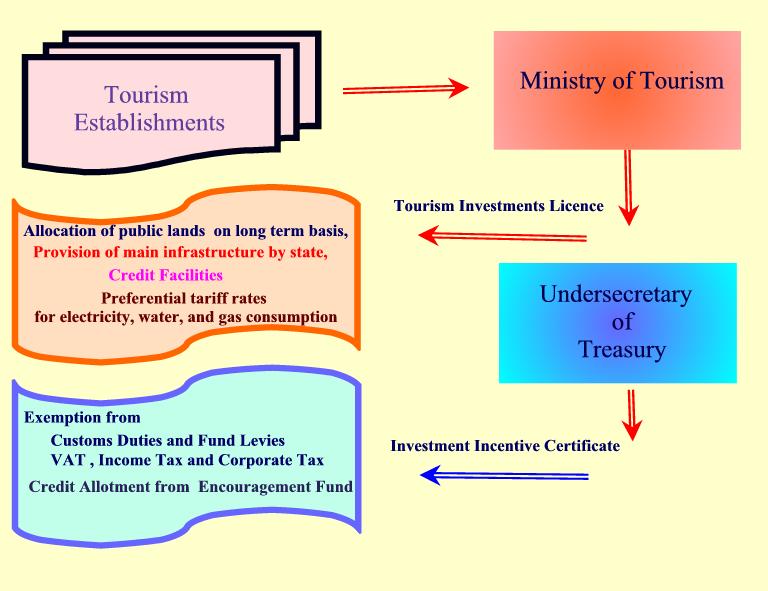
Also according to ,DECREE CONCERNING STATE
ENCOURAGEMENTS TO INVESTMENTS AND THE INVESTMENT ENCOURAGEMENT FUND ;There
are two aspects of State aids for Investment in Tourism sector , First
concerns the fund-based credits and the second covers the exemptions from
VAT, customs taxes, stamp and duties and the investment allowances (tax
holidays).
In order to benefit from the
elements of encouragement, it is necessary to obtain an
investment encouragement certificate, for
which the application principles are determined by the
Undersecretariat of Treasury .In order to receive an encouragement
certificate, the investment must have a minimum amount of 25 Billion
Turkish Lira (TL) ( ~ 50.000 $ ) as fixed investment, if the investment is
in the Priority Development Region, and a minimum amount of 50 Billion TL (
100.000 $ )for investments in other regions.
According to the investment incentive
certificate The State aids are;
- Exemption from Customs
Duties and Fund Levies: The machinery and equipment imported according
to the Investment Incentive Certificate have exemption from Customs
Duties and Fund Levies for 100%.
- Exemption from VAT: If
the Investment Incentive Certificate has shown on the Customs both
export and locally purchased machinery and equipment for production line
have exemption from VAT.
- Exemption from
Investment: Addition with the total price of the machinery and equipment
and total amount of investment cost. The result should be substracted
from the taxable values.
- Exemption from the Taxes,
Duties and Fees: The investors who commit to realize 10.000 US Dollars
of exports upon the completion of the investment are granted exemption
from the taxes, duties and fees.
- To benefit from the
Encouragment Fund: The installment of the yearly taxes which have been
paid to the government could be postponed. Because the payable tax
amount will be used for the Investment Encouragement.
- Exemption from Income
Tax and Corporate Tax: In First Priority and Extraordinary Situation
Regions, the companies who are newly established and have more than 10
employees are exemption from Income Tax and Corporate Tax for five years.
- Other Taxes and Fees: In
First Priority and Extraordinary Situation Regions, the companies who
have the investment incentive certificate granted exemptions from
housing taxes, stamp tax, bank tax, inheritance tax and other taxes
which have to be paid to the Municipalities.
- Energy Incentives: This
incentive measure enables the investors to benefit from a 50% reduction
in their electricity expenses within the following city boundaries: Van,
Diyarbakır, Siirt, Tunceli, Şırnak and Hakkari. This incentive shall be
applied during the validity of the incentive certificate.
- Investment in the
Developed Regions: The investments which might be granted the investment
incentive certificate in the Developed Regions as follows:
- Electricity
production
- Infrastructure
investments
- Investments under
the BOT and/or BOO scheme
- Investments related
to R&D, design and producing new products or models
- Investments for
environmental protection
- Priority technology
investments determined by the Higher Council of Science and
Technology
- Electronic sector
investments
- Boat and yacht
construction
- Shipyard investments
- Technopark,
information technology, education, health, tourism telecommunication
and certain service sector investments
- Capacity increase,
modernization, quality improvement and integration investments
- Projects which are
over 50 million US Dollars with at least one of the following
requirements; high-tech, increasing employment, high level of value
added and increasing tax revenues.
- Exception from the tax
and fees: According to the temporary article 2, of 3505 numbered law,
dated 3.12.1988; If an investor committed that he can make exportation
for 10.000 US Dollars in two years after completion of the investment:
- Establishment of a
company
- in the investment
period, not to pass the total amount of the investment could be
multiplying according to the investment incentive certificate
- According to the
investment incentive certificate, the credits granted from both
international and the local banks. The credit amounts should be less
than the foreign investment cost.
- About the incentive
certificated investments have a building/land etc. should be
registered to the deed office as an own good of the investor.
- Credit Allotment from
the Encouragement Fund: The frame of the instruction from the
Undersecretariat of Treasury, investors may grant an allotment from the
Encouragement Fund for R&D, technopark, environmental protection and
KOBI investments.
- Change of Investment
Place and Investment Subject: It is necessary to inform to the
Undersecretariat about investment place changes. The Undersecretariat
takes the necessary action according to the law terms to prepare / un
prepare new incentive certificate. If the old investment place have more
state aid elements than the new place the Undersecretariat will take
back some state aid elements from the investor. In the event of
investment subject change, the investor has to provide a new information
form to the Undersecretariat. According to the information form the
Undersecretariat will take the necessary actions to revise the
investment incentive certificate.
- Revising of the
Incentive Certificate: The recorded elements on the investment incentive
certificate never be finalized. They can be changed every step of the
investment. Investors could be provided above mentioned changes to the
Undersecretariat with the documentation any step of the investment. The
investment value might be upgraded/downgraded 100% as well. In this case,
the Undersecretariat will revise the investment incentive certificate
appropriately.
- Time Extension: The
investments have to be finished the foreseen timeframe on the investment
intensive certificate. If the investments would not be completed
foreseen timeframe, the investor has to apply for time extension, 6
months before or 6 months after the expiration date either to the
Chamber of Commerce or the Undersecretariat. If the time extension
request approves by the Chamber of Commerce the documents will be
forwarded to the Undersecretariat for the necessary procedures. On the
investment incentive certificate foreseen time extension (including
additional time) would be six (6) months. If the investment will not be
completed during this timeframe the investment incentive certificate
will be cancelled.
- Transfer, Sell and
Import of the Certificate: According to the laws, Investment Incentive
Certificate which completion visa has not given yet can be examined
again by the Undersecretariat and can be provided the revised
certificate to the investor.
- To import used Machinery
Equipment and Facilities: The complex facility used according to the
investment incentive certificate could be imported after studying the
projects by the Undersecretariat. The used machinery and equipment could
be imported according to the Importation Regime Decision. The used motor
vehicles can not be imported.
Tourism investments
(overnight encampment facilities) with an Investment Encouragement
Certificate issued in accordance with the previous Decree No. 94/6411 dated
26.12.1994;
- must be confirmed by a report from the
Turkish Emlak Bank, within a period of one year after the date of
publication of this Decree, taking into account the escalated values,
and indicating that the physical realization rate of the investment
(including land), is at least 70%.
- must not have benefited from the Fund
Sourced Credit, in relation with the previous provisions of the
framework concerning Partially Completed Tourism Investments legislation
(if the investment has partially benefited from the credit mechanism
previously, the difference between the credit to be allocated in
accordance with this Decree and previously used amount shall be taken
into evaluation),
- must have the characteristics of a
completely new investment.
The capacity increases
realized after the publication of this Decree shall not be taken into
consideration ,With these conditions stated above, if an application is
submitted to the Undersecretariat within one year after the publication of
this Decree, in order to finance the incomplete portion of the investment,
maximum 70% of the remaining investment can be credited from the Fund. This
credit has 50% interest rate, having 2 years grace period, and 5 year
maturity term.
Investments to be financed in
this framework should be completed at the latest within one year period and
application should be given to the Undersecretariat for the completion visa.
Otherwise, the encouragement elements shall be taken back with sanctions.
SME's, in other words, the
enterprises that qualify for the state aids are defined by the published in
State Aids Decree as follows: “Businesses that employ a maximum of 150
workers, the net value of machinery and equipment, plants, vehicles, tools
and appliances, furniture and fixed inventory excluding the land and
buildings recorded in their legal books and documents is at most 100 billion
TL.” However, of such businesses, the ones that operate in the services
sector and tourism do not qualify. It is compulsory that they are in the
manufacturing sector. The total net value of TL 100 billion of balance sheet
and machinery and equipment is applicable until the end of this year. This
figure will be increased every year .
HALKBANK TOURISM CREDITS ;Halk
Bank will carry out special loan program for tourism,
|
BENEFICIARIES
OF THE CREDIT: |
Hotel, Motel, Pension,
Holiday Village, Camping, Rural Tourism
Facilities (Plateau and
Mountain Tourism or natural facilities ( river , cave, etc.) ,
Thermal Tourism Facilities ( hot spring, mud bain) and
Yacht Management Firms
with tourism certificate given by the Ministry,
Tourism Offices or
Municipalities . |
| TYPE OF THE
CREDIT: |
Credits
are used by establishment and operation credits to cover fixed and
furnitures and operating expenses of tourism firms. |
| GUARANTEE: |
Personal guaranty,
mortgage, commercial management warrant,
commercial pledge,
treasury bond warrant and other securities. It can be
accepted Credit Guarantee
Fund’s guarantee in case of inability to give
sufficient Guarantee.
|
| LIMIT: |
150 Billion TL( ~ 300.000
$ ). for the firms defined as SME by the bank. The stable limit
is determined for other firms except SME definition according to
the needs and depending
on the project. |
| TERM: |
For SMEs and Big-sized
establishments,
2- 8 years in
establishment credits,
2- 6 years in operation
credits,
It can be applied grace
period up to 2 years when it is necessary. |
| INTEREST:
|
85 % for SMEs ( 75-85 %
in monthly equal installments)
110 % for Large -Sized
Enterprises ( 95-105 % in monthly equal installments) |
| BITT: |
5 % (Bank
Insurance Transaction Tax) |
|
SFUC
(Support Fund for Using
Credit) : |
3 % for
Big-Sized Enterprises, it is not applied for SMEs. |
| COMMISSION:
|
2 %
|
EXIMBANK TOURISM MARKETING
CREDIT
| BENEFICIARIES
OF THE CREDIT: |
With the
aim of promoting tourism sector and providing financial support for
international marketing function of travel agencies; Tourism
Marketing Credit is used by the bank for travel agencies with the
certificate of Group A provided foreign exchange up to $ 1.000.000
in a year. |
| LIMIT: |
50 % of
the total expenditures in proforma project is credited.( This amount
should not exceed 250 Billion T.L. ( 510.000 $ ) and 30 % of the
previous year‘s sales of the travel agency. )
This amount should not
exceed;
5% of total foreign
exchange amount in equivalent of Turkish Liras for the travel agency
provided $ 1-10 Million foreign exchange amount in a previous
calendar year.
7% of total foreign
exchange amount in equivalent of Turkish Liras for the travel agency
provided over $ 10 Million foreign exchange amount in a previous
calendar year. |
| TERM |
max. 12
months. |
| INTEREST
( %) |
|
TERM ( Month) |
INTEREST ( %) |
|
4
|
67
|
|
6
|
72
|
|
9
|
75
|
|
12 |
79 |
|
INPUT / OUTPUT ANALIS of TOURISM SECTOR
% of Input from Related Sectors to Tourism Sector
| 1)Farming of Animals
|
13,40 |
| 2)Wholesaling and
Retailing |
11,79 |
| 3)Highway Transportation |
9,84 |
| 4)Agriculture |
8,91 |
| 5)Other Food Products |
6,99 |
| 6)Individual and
Professional Services |
6,46 |
| 7)Alcoholic Beverages |
4,37 |
| 8)Sugar Production |
4,26 |
| 9)Banking and Insurance |
3,08 |
| 10)Communication |
2,57 |
| 11)Other Petrolium and
Coal Products |
2,35 |
| 12)Petroleum Refining |
2,20 |
| 13)Non-alcoholic
Beverages |
2,16 |
| 14)Vegatable Oil and
Fats |
2,00 |
| 15)Ground Cereal
Products |
1,89 |
| 16)Fishing |
1,68 |
| 17)Slaughterhouse
Products |
1,65 |
| 18)Paper and Paper
Products |
1,60 |
| 19)Electricity |
1,50 |
| 20)Pharmatical Industry |
1,46 |
| 21)Hotel, Restaurant,
Cafe |
1,35 |
| 22)Gas and Water |
1,33 |
| 23)Chemical Fertilizer |
1,11 |
| 24)Metal Products |
0,92 |
| 25)Forestry |
0,89 |
| 26)Textile |
0,70 |
| 27)Tobacco |
0,69 |
| 28)Printing,Publication
and Bookbinding |
0,68 |
| 29)Other Non-metallic
Mineral Products |
0,52 |
| 30)Vegatable and Fruit
Processing |
0,50 |
| 31)Coal Mining |
0,41 |
| 32)Maritime Line
Transportation |
0,31 |
| 33)Plastic Products |
0,17 |
| 34)Glass and Glass
Products |
0,11 |
| 35)Airway Transportation |
0,07 |
| 36)Other Manufacturing
Industry |
0,05 |
| 37)Railway
Transportation |
0,04 |
| TOTAL INPUTS |
100 |
PROJECTS Of
TURSAB for 2000
|
ANATOLIA 2000, NEW
MILLENIUM CELEBRATIONS
Turkey has been the cradle of
successive civilizations throughout its history, it has been
homeland of many diverse cultures, religions, faiths which
altogether created its unique heritage.
TÜRSAB,
is at present working on a major project aiming to share all those
values and the joy of the NEW
MILLENIUM
CELEBRATIONS with all the people of the world wishing for peace and
happiness on the turn of the century and through the NEW
MILLENIUM. |
INTERNATIONAL MEETINGS & INCENTIVE TRAVEL EXCHANGE
Turkey has enjoyed a staggering
increase in demand in a wide range of market segments. Meetings and
incentive travel is one particular area where demand falls well
short of what it could have been, with regard to Turkey’s share in
the world, though Turkey offers excellent facilities and perfect
services as witnessed in a number cases of international conventions
and congresses.
TÜRSAB
staged “International Meetings & Incentive Travel Exchange” in 1997
in Izmir and in 1998 in Antalya. The aim of the event is to prepare
a ground to exchange of information and views, on this specific
subject and promote Turkey to increase its share in incentive travel
and meetings, convention market, by bringing buyers and trade
members and all other concerned parties together.
The third EXCHANGE will be held in
Cappodocia between 14 –
17 October 1999. |
|
EMITT’99 – VOYAGER
East Mediterranean International Tourism and Travel
Exhibition
This year sees a major international event in
Istanbul which brings the members of tourist trade and pubic
together from all over the world.
EMITT Voyager 99, the most
important fair of East Mediterranean area, realised by leading
tourism organizations of Turkey provides opportunity to exchange
views and information and to do business.
EMITT Voyager will continue to
be the meeting place in coming years. |
|
BLACK SEA TOURISM CO-OPERATION (BSTC)
; Black Sea: Destinations 2000’s
1990s saw revolutionary changes; a part of Euro-Asian
map has been redrawn, opening up a new world, new
horizons.New vision, new hopes,
new expectations, all around Black Sea, have created a desire for
further co-operation in every sphere of life.
The aim of
BSTC
is to promote tourism to and in the Black Sea
Area.BSTC
Working Committee is now working on future plans and joint projects
such as multy
centre and special interest tours, Black Sea Cruise, Black Sea Art
Festival.
On 10th
March 1998 representatives of associates of travel agencies of five
Black Sea Countries met to exchange view and ideas on co-operation
in tourism upon invitation of the Association of Turkish Travel
Agencies.On the second
meeting held on 9th
May 1998 in İstanbul, an
agreement titled “Black Sea Tourism Co-operation (BSTC)
Working Document of Participating Countries” was signed.
Establishment procedures are still on progress with the aim of
participation of travel agencies associations of eleven Black Sea
Countries. |
| Source : TURSAB |
For further information contact Mr Mehmet Atilla Sögüt,
to whom you can send remarks and recommendations
Addres : Mehmet Atilla SÖGÜT
Abdulhak hamit Caddesi No : 866 06470 Altmışevler
Mamak ANKARA TURKEY
Tel : (+ 90 312) 5952784 Fax : (+ 90 312) 3680715
Mobile (+90 532) 4935390
e-mail : atilla.sogut@kosgeb.gov.tr
|


